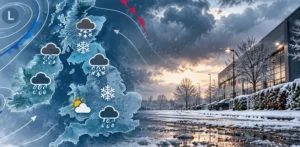
Salt spreading can look straightforward from the outside: temperatures fall, a gritting vehicle arrives and salt goes down. But a well-managed commercial gritting service involves several decisions before an operator reaches your site.
Facilities and property managers need to know when treatment is necessary, where it should take place and whether it has been completed as planned. That requires accurate forecasting, agreed treatment triggers, sensible route planning and clear service evidence.
Here is how the process works.
1. What salt spreading is designed to achieve
Commercial salt spreading helps reduce the risk of ice forming on treated outdoor surfaces and supports safer access during cold weather.
Winter maintenance should help keep important areas such as car parks, pedestrian routes, entrances and delivery areas accessible when temperatures fall.
A proactive gritting service therefore focuses on treating agreed areas when forecast conditions indicate that action is needed.
This distinction matters. A good service does not simply send operators out whenever the air feels cold. It uses site-specific information and agreed criteria to decide whether treatment should take place.

2. Weather, surface temperature and treatment triggers
One of the most important factors in a salt spreading decision is the forecast road surface temperature.
Air temperature and road surface temperature are not the same thing. A weather app might show an air temperature above freezing while the surface of a car park or access road falls to a temperature where ice becomes a concern.
Commercial winter gritting should therefore use professional, site-specific forecasts that consider road surface temperature and local conditions.
Before the winter season, the provider and client can agree a trigger temperature for each site. At OUTCO, for example, this will commonly be a forecast road surface temperature of 0°C or below. Clients who need an additional level of protection can agree higher activation temperatures alongside specified conditions.
When the forecast meets those agreed criteria, it can trigger a service visit.
This approach makes the decision more consistent. Instead of relying on a general regional forecast or someone checking the temperature manually, the winter maintenance plan links action to conditions relevant to the individual site.
3. Timing before frost and ice risk
Timing plays a major part in effective salt spreading.
The objective of proactive treatment is to get the de-icing product onto the agreed surfaces at the appropriate point before hazardous conditions develop, rather than waiting for widespread ice to form.
That means the provider needs to interpret the site-specific forecast, identify the expected period of risk and schedule treatment accordingly.
Site operations matter too.
A busy retail park, logistics centre, healthcare facility and office campus can have very different operating patterns. Delivery windows, shift changes, customer opening hours and vehicle movements can all affect when a gritting service can access the site efficiently.
For that reason, commercial winter maintenance planning should consider both the weather and the way the property operates.
4. Routes, priority areas and exclusions
Not every part of a commercial property necessarily requires the same treatment.
A site survey helps establish the areas included within the winter gritting plan before the season begins. Depending on the property, this might cover:
- car parks
- main vehicle routes
- pedestrian footpaths
- entrances and exits
- loading and delivery areas
- other agreed high-use or priority areas.
Mapping these areas in advance helps the provider understand the treatment route and select suitable equipment. It also gives the client clarity.
A winter maintenance agreement should make it easy to identify what the provider will treat and, just as importantly, what falls outside the agreed scope.
That becomes particularly important on complex or multi-site estates. A facilities manager should not have to guess whether a particular footpath, loading area or secondary access road forms part of the salt treatment route.
5. Product use and site conditions
The provider needs to consider the treatment product, surface, site conditions and expected weather.
OUTCO primarily uses white marine salt for commercial gritting. It offers an effective de-icing option while minimising the staining and residue often associated with traditional brown rock salt.
Equipment also needs to match the site. Large open areas may suit vehicle-mounted or towed spreading equipment, while pedestrian routes and restricted areas may require a different approach.
A pre-season site survey helps establish these requirements. It can account for factors such as surface type, site layout, access and the areas that require treatment.
Conditions can also affect what salt can achieve.
For example, salt spreading and snow clearance perform different jobs. When significant snow accumulates, spreading salt alone may not provide an appropriate solution. The winter plan may need to include mechanical snow clearance, manual clearance or specialist de-icers depending on the site and conditions.

6. Evidence and post-visit checks
For a facilities manager, completing the salt spreading visit is only part of the process. You also need evidence that it happened.
This becomes particularly important when you manage several locations or need to demonstrate winter maintenance activity internally.
A useful service record should tell you when the visit took place and provide evidence of the work completed.
OUTCO clients can view current and planned visits through the Service Portal. Progressive job statuses show when a visit is scheduled, when they are on site and when the work has been completed.
Following a visit, downloadable service reports can provide photographic evidence alongside GPS start and finish locations and breadcrumb tracking of the service activity.
This creates a clear audit trail rather than relying on a simple statement that a site was gritted.
For multi-site facilities teams, this type of reporting can also reduce administration. Instead of contacting individual sites or contractors to confirm whether winter gritting took place, managers can review service information through a central platform.
Post-visit visibility also helps identify exceptions. If an operative encounters an access problem or another issue on site, the facilities team needs to know so it can decide what action to take next.
7. Questions to ask a salt spreading provider
When comparing commercial gritting providers, price matters, but it should not be the only question.
Ask how the provider makes its operational decisions.
- What weather information do you use?
- Do you use road surface temperature?
- What triggers a visit?
- Which areas of my site will you treat?
- When will you attend?
- What salt or de-icing product will you use?
- What happens during snow or more severe conditions?
- How will I know the work has been completed?
- What happens if conditions change?
Making salt spreading a managed process
Effective salt spreading depends on a chain of operational decisions.
It starts with understanding the site. Professional, site-specific weather forecasts then help identify when surface conditions could create a risk. Agreed trigger temperatures inform treatment decisions, while planned routes, suitable products and appropriate equipment support delivery.
Finally, service records provide evidence of what happened on the ground.
For facilities managers, that visibility matters. A commercial gritting service should give you a clear answer to three basic questions: why was treatment required, what areas were treated, and can you verify that the work took place?
OUTCO combines site-specific professional forecasting with pre-agreed treatment criteria, planned winter gritting and documented proof of service. The result is a structured approach designed to help facilities and property managers keep outdoor areas safe, accessible and operational while reducing the administrative burden of managing winter conditions.