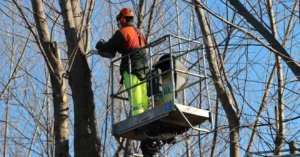
Trees enhance estates. They improve visual appeal, support biodiversity and contribute to environmental targets. But unmanaged trees present material risk, from falling branches and root damage to blocked drains and structural impact.
The Legal Duty of Care
Under UK health and safety and occupiers’ liability legislation, organisations have a duty to take reasonable steps to prevent foreseeable harm. That duty extends to trees on commercial land.
Facility managers should assume accountability for:
- Trees within site boundaries
- Trees adjacent to public footpaths or highways
- Trees near car parks, pedestrian routes or building entrances
- Trees affecting neighbouring properties
If a tree or branch fails and causes injury or damage, the central question will be: Was the risk reasonably foreseeable, and was it managed appropriately?
A documented tree survey is often the difference between defensible due diligence and avoidable liability.
Why 2026 Demands Greater Oversight

Several factors are increasing scrutiny around tree management:
1. Climate Volatility
More frequent storms, high winds and prolonged periods of drought are placing additional stress on tree stock. Root systems weakened by saturated soil or extended dry spells are more susceptible to failure.
Facilities teams can no longer rely on historic patterns to predict stability. Dynamic weather conditions demand proactive inspection cycles.
2. Increased Public Footfall
Retail parks, healthcare estates and mixed-use developments continue to prioritise accessible, landscaped environments. Higher footfall increases exposure. A branch failure in a remote corner of an industrial estate is one matter; failure near a hospital entrance is another.
Risk is directly linked to location and usage.
3. Regulatory and ESG Pressure
Environmental, Social and Governance (ESG) reporting is now embedded in many corporate strategies. Biodiversity and tree retention are positive indicators but they must be balanced with safety.
The expectation in 2026 is not simply to preserve trees, but to manage them responsibly.
What a Professional Tree Survey Should Cover

A tree survey is not a cursory visual check. It is a structured, risk-based assessment carried out by a competent arboricultural professional.
Facility managers should expect surveys to include:
- Identification and tagging of trees
- Assessment of structural integrity
- Identification of disease, decay or fungal growth
- Evaluation of root stability and soil conditions
- Proximity risk analysis (buildings, roads, public access)
- Risk rating based on likelihood and impact
- Clear recommendations for action
These recommendations may range from routine pruning to crown reduction, bracing, or full removal in high-risk cases.
The key is documentation. If a tree is identified as medium or high risk, action timelines must be recorded and followed.
Frequency: How Often Is Enough?
There is no universal inspection frequency. Instead, intervals should be based on:
- Tree species and age
- Site usage and footfall
- Exposure to prevailing weather
- History of previous issues
As a general guide, many commercial estates adopt:
- Formal surveys annually or bi-annually
- Post-storm inspections following severe weather events
- Targeted inspections for high-risk zones (entrances, car parks, healthcare access routes)
The principle is proportionality. Higher-risk environments require shorter review cycles.
Liability: The Cost of Inaction
Tree-related incidents can result in:
- Personal injury claims
- Property damage
- Vehicle damage in car parks
- Service disruption
- Reputational damage
- Regulatory investigation
In legal proceedings, claimants often request maintenance records and inspection evidence. A lack of documented survey history significantly weakens defence.
Conversely, a well-maintained audit trail including survey reports, remedial works records and follow-up inspections, demonstrates responsible estate management.
Compliance is not about eliminating every risk. It is about demonstrating that risks were identified and managed reasonably.
Integrating Tree Surveys into Estate Strategy

Tree surveys should not sit in isolation. They form part of a wider external risk management strategy that includes:
- Grounds maintenance
- Drainage management
- Hard surface inspections
- Winter planning
- Biodiversity management
Integration means that tree-related risks, such as root damage to pavements or blocked drains from leaf fall, are addressed holistically rather than reactively.
In multi-site portfolios, consistency is essential. A single unmanaged site can undermine broader compliance standards.
Balancing Safety with Environmental Responsibility
Tree removal is sometimes necessary, but it should not be automatic. Responsible management considers:
- Retention where safe
- Remedial pruning before removal
- Replacement planting strategies
- Biodiversity impact
Facility managers increasingly need to balance liability with environmental commitments. A structured survey allows informed decisions rather than reactive removals driven by fear of litigation.
Questions Facility Managers Should Be Asking in 2026
To determine robust tree management, decision-makers should consider:
- Do we have a current, documented tree survey for every site?
- Are high-risk areas inspected more frequently?
- Can we evidence completion of recommended works?
- Are inspections carried out by qualified professionals?
- Do we have a post-storm inspection protocol?
- Is tree management aligned with our ESG objectives?
If the answer to any of these is unclear, there may be exposure.
From Landscaping to Governance

Trees contribute positively to estate quality, biodiversity and brand perception. But in 2026, they must also be viewed through a governance lens.
Tree surveys are not optional extras or purely aesthetic exercises. They are structured risk assessments that protect people, assets and organisational reputation.
For facility managers operating in retail, healthcare, logistics and commercial estates, proactive tree management demonstrates control, compliance and professional stewardship of the built environment.
OUTCO provides professional tree surveys and arboricultural services as part of its wider grounds and external estate management offering. Through structured reporting, risk-rated assessments and clear remedial recommendations, OUTCO supports facility managers in meeting compliance obligations while maintaining safe, well-managed outdoor environments.