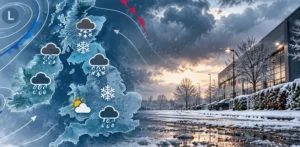
When temperatures fall, a public weather forecast can tell you that a cold night lies ahead. But effective Winter Gritting requires more precise information. Facilities teams need to understand what is likely to happen at the surface of their car parks, access roads and footpaths, and whether conditions meet the agreed threshold for treatment.
That is why OUTCO bases winter maintenance decisions on site-specific professional weather forecasts, road surface temperatures and agreed treatment triggers. This approach helps clients protect access, reduce unnecessary treatment and spend less time making daily weather decisions themselves.
Why the Headline Forecast is Not Enough
Public forecasts provide useful information about general weather conditions. However, they cover relatively broad areas and often focus on air temperature.
For Winter Gritting, the key question is more specific: will surfaces at a particular site reach a temperature where ice could form?
Two properties within the same town can experience different conditions. Altitude, exposure, surrounding buildings, surface materials and other local factors can all influence how quickly a surface cools.
A general forecast may therefore suggest relatively mild conditions while a particular site still faces an ice risk.
Air Temperature Versus Surface Temperature
Air temperature and Road Surface Temperature (RST) are not the same.
A weather forecast may show an overnight air temperature above freezing, while exposed surfaces fall to 0°C or below. Equally, some surfaces may remain above freezing even when the surrounding air becomes colder.
For this reason, professional winter maintenance decisions should not rely on air temperature alone.
OUTCO uses location-specific professional forecasts and RST data to support gritting services.
This provides a more relevant basis for deciding whether treatment is required and helps ensure visits take place when site conditions meet the agreed criteria.
Forecast Confidence and Local Variation
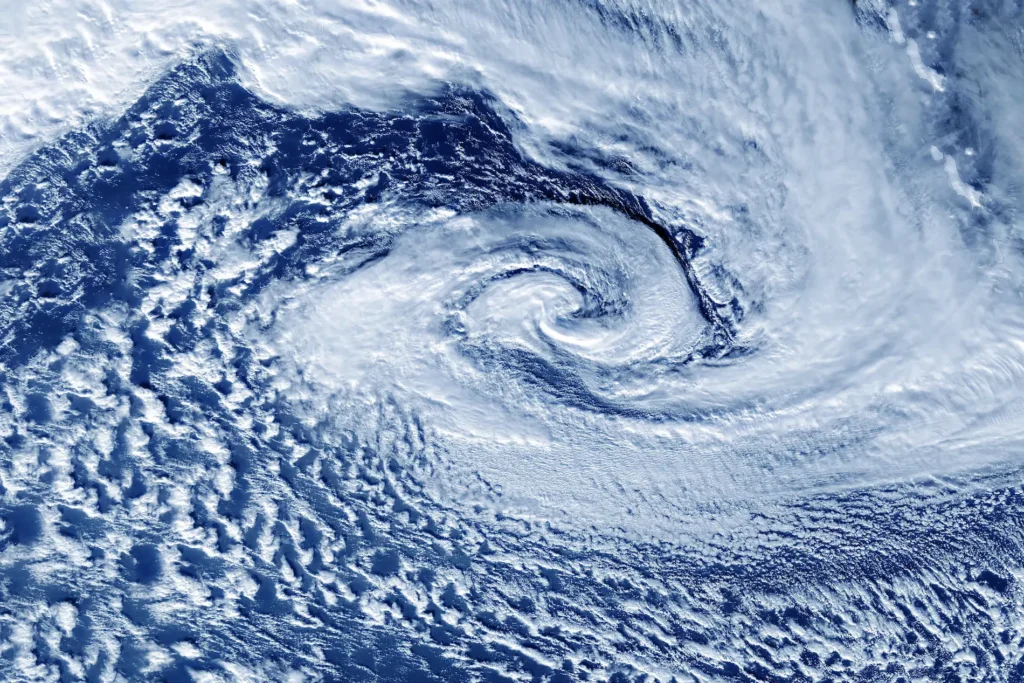
No weather forecast can remove uncertainty completely. Conditions can change, and local variation matters.
A robust Winter Gritting plan accounts for this rather than relying on a single headline temperature.
Site-specific professional forecasts give OUTCO a more precise view of expected conditions at each location. This becomes particularly important when managing large property portfolios, where sites can face very different conditions on the same night.
OUTCO manages around 8,000 winter sites nationwide. Combining that scale with location-specific forecasting allows treatment decisions to reflect local conditions while maintaining a consistent service model across a portfolio.
Agreed Treatment Triggers
A treatment trigger defines the conditions that activate a winter gritting service.
Before the winter season, OUTCO surveys each site and agrees an appropriate Road Surface Temperature trigger with the client. A common trigger is an RST of 0°C or below, while sites requiring additional protection can use higher activation temperatures with specified conditions.
Once the forecast meets the agreed criteria, the service can be activated without the facilities team having to review forecasts and make treatment decisions each day.
This creates a clear process for both parties. It also helps avoid unnecessary de-icing visits when conditions do not meet the agreed trigger, reducing cost, salt use and administrative workload.

Site-Specific Risk and Priority Areas
Temperature data forms only part of a good Winter Gritting plan. The physical characteristics and use of the site matter too.
A pre-season site survey can identify areas such as entrances, pedestrian routes, car parks, loading areas and other high-use locations that require treatment. It can also account for surface types, access requirements and operational priorities.
This site-specific approach helps direct treatment towards the areas that matter most to safety and business continuity.
Decision Records and Communications
Good Winter Gritting does not end when salt reaches the ground. Facilities teams also need evidence of what was planned, what happened and when.
OUTCO’s technology supports this process from service activation through to completion. Clients can use the OUTCO Service Portal to view job status, access service records and download reports with photographic evidence, GPS information and proof-of-service data.
This creates an auditable record without requiring facilities teams to chase contractors for updates or manually compile information.
During winter, OUTCO also provides 24/7 support, giving clients a direct route for questions, changes and additional service requests.
Turning Weather Data into Practical Winter Decisions
Effective Winter Gritting depends on translating weather information into clear operational decisions.
Headline forecasts provide useful context, but site-specific professional forecasts, Road Surface Temperature data and agreed treatment triggers provide the detail needed to plan treatment with greater precision.
For facilities and property managers, that means less time interpreting forecasts, coordinating contractors and gathering service evidence.
OUTCO combines professional forecasting, site-specific planning, nationwide delivery and digital reporting to manage that process on the client’s behalf.
The outcome is a simpler approach to winter maintenance: treatment based on agreed conditions, clear records of service delivery and greater visibility across every site.