For organisations responsible for keeping commercial sites safe and operational, appointing gritting contractors should never be left until cold weather arrives. Effective winter procurement begins months before the first credible frost, giving facilities management teams and property managers time to define service requirements, compare suppliers, complete site surveys and fully mobilise winter maintenance services before seasonal demand increases. Early planning improves supplier choice, reduces operational risk and helps to make sure your sites remain compliant throughout the winter season.
Many organisations treat winter maintenance as an annual purchase. In reality, it is a business continuity exercise. By the time freezing temperatures arrive, the most experienced winter maintenance contractors have already completed surveys, planned routes, allocated resources and agreed mobilisation programmes. Delaying procurement until autumn often limits supplier availability and reduces the time available for planning.
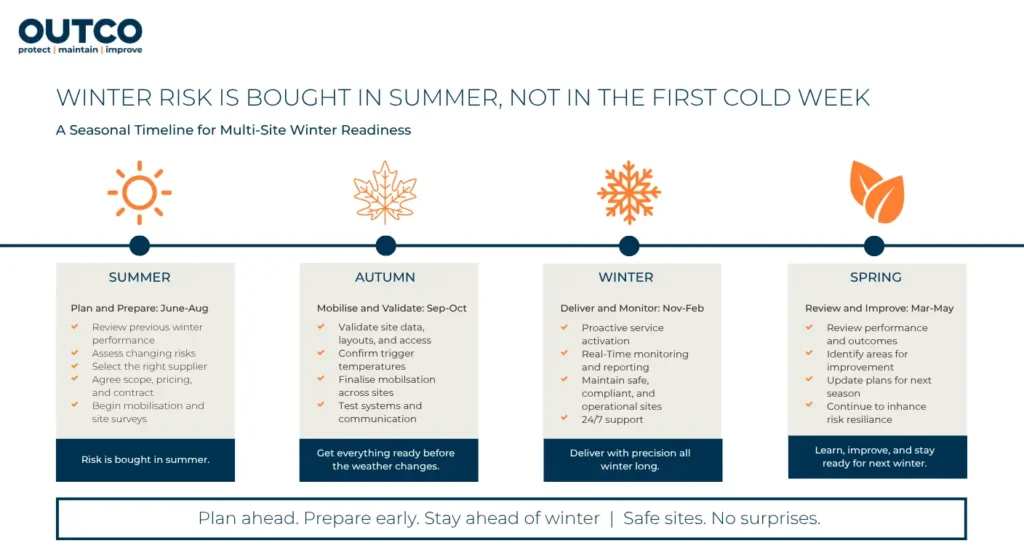
Work Backwards from the First Credible Frost Risk
Rather than working towards the start of winter, work backwards from the first period when your sites could realistically experience freezing conditions.
This allows sufficient time to:
- Review previous winter performance
- Complete a winter risk assessment
- Define service requirements
- Tender your winter maintenance contract
- Carry out site surveys
- Mobilise services before operational demand increases
Planning in this way also gives procurement teams more time to evaluate commercial gritting services on quality, capability and long-term value rather than simply comparing price.
July: Define Sites, Risk and Service Scope
July is the ideal time to establish exactly what your organisation requires from its winter maintenance services.
Every site should be reviewed individually, as layouts, operating hours and operational priorities often change from year to year.
Your scope should include:
- Vehicle routes
- Pedestrian walkways
- Delivery yards
- Emergency access routes
- High-risk areas
- Snow clearance requirements
- Grit bin locations
- Preferred pricing model
- Reporting requirements
This is also the time to decide whether you require fixed-cost, pay-per-visit or hybrid pricing for your winter maintenance contract.
A clearly defined specification allows suppliers to provide accurate quotations and tailored recommendations rather than generic pricing.

August: Survey and Compare Suppliers
August should focus on evaluating potential gritting contractors.
Professional suppliers will normally undertake site surveys before producing final proposals. These surveys identify treatment areas, access constraints, spreading methods, trigger temperatures and operational considerations unique to each property.
When comparing suppliers, consider more than cost.
Evaluate:
- Experience across similar commercial estates
- Nationwide capability
- Availability of site-specific professional weather forecasts
- Trigger temperatures (will a supplier only service your site when in ‘Red’ conditions or do they provide services in ‘Amber’ conditions as well, giving you that extra peace of mind?)
- Winter gritting and snow clearance services
- Service evidence and audit trails
- Technology and reporting
- 24/7 operational support
- Health and safety standards
- Insurance and compliance
Technology should form part of every procurement decision. Access to digital reporting, GPS verification and photographic proof of service reduces administration while strengthening compliance. OUTCO’s Service Portal provides clients with live job status, downloadable service reports and GPS-backed proof of service, helping facilities managers manage winter operations with greater visibility and confidence.
September: Agree Pricing, Exclusions and Governance
By September your preferred supplier should be identified, allowing attention to move towards contract completion.
Before signing your winter maintenance contract, ensure there is agreement on:
- Pricing structure
- Trigger temperatures
- Service inclusions
- Exclusions
- Key Performance Indicators
- Reporting requirements
- Escalation procedures
- Governance meetings
- Responsibilities during prolonged winter events
Well-defined governance reduces uncertainty during severe weather and creates clear expectations for both parties.
October: Mobilise Sites, Routes and Contacts
October should be reserved for mobilisation rather than procurement.
Typical mobilisation activities include:
- Confirming treatment maps
- Uploading site information
- Finalising service routes
- Allocating operational teams
- Verifying emergency contacts
- Confirming access arrangements
- Testing communications
- Preparing reporting systems
Completing mobilisation before the first frost helps determined that every location is ready for service from day one.

Supplier Decision Gates
Introducing structured decision gates throughout the procurement process helps makes sure suppliers are evaluated consistently and reduces the likelihood of issues emerging once winter begins.
Decision Gate 1 – Procurement Approval (July)
Confirm:
- Site list
- Winter risk assessment
- Budget approval
- Procurement timetable
- Service scope
Decision Gate 2 – Supplier Evaluation (August)
Assess each supplier against:
- Relevant sector experience
- National coverage
- Site-specific professional weather forecasts
- Trigger Activation Temps
- Winter gritting capability
- Snow clearance services
- Service reporting
- Technology platform
- References and case studies
- Financial stability
Decision Gate 3 – Contract Award (September)
Before awarding the contract, confirm:
- Pricing
- Service levels
- KPIs
- Insurance
- Governance
- Mobilisation programme
- Responsibilities and exclusions
Decision Gate 4 – Operational Readiness (October)
Before winter begins, verify:
- Site surveys completed
- Treatment maps approved
- Contacts confirmed
- Reporting systems operational
- Routes allocated
- Mobilisation complete
Only once these stages have been completed should your contractor be considered fully operational.
What Late Procurement Changes
Although it is still possible to appoint gritting contractors later in the year, procurement becomes more challenging as winter approaches.
Late procurement may result in reduced supplier availability, compressed mobilisation programmes, limited survey opportunities, less flexibility over pricing models and greater operational risk.
The busiest period for winter maintenance contractors naturally occurs immediately before the winter season begins. Early procurement allows both supplier and client to prepare properly rather than reacting under unnecessary time pressure.
July to October Winter Procurement Timeline
| Month | Procurement Activity | Supplier Decision Gate |
| July | Review previous winter performance, complete risk assessments, define service scope and budget. | Internal approval to begin procurement. |
| August | Undertake site surveys, compare gritting contractors, evaluate commercial gritting services, reporting capability and technology. | Select preferred suppliers and shortlist. |
| September | Agree pricing, KPIs, governance, trigger temperatures, exclusions and award the winter maintenance contract. | Contract approval and mobilisation sign-off. |
| October | Finalise treatment plans, allocate resources, confirm contacts, upload site data and complete mobilisation. | Operational readiness confirmed before the first credible frost. |
Starting procurement in July gives organisations the time needed to make informed decisions, complete mobilisation properly and secure the most appropriate winter maintenance services before supplier capacity begins to tighten.
Book a Winter Procurement Review
If you’re planning ahead for winter 2026/27, now is the ideal time to begin your procurement process.
OUTCO can help you review your portfolio, assess site-specific risks, define service requirements and prepare a procurement programme that supports safe, compliant and uninterrupted operations throughout the winter season.
Book a Winter Procurement Review and start planning before winter demand begins to build.