For organisations responsible for multiple locations, winter maintenance planning should begin long before temperatures start to fall. By July, facilities and procurement teams have the opportunity to review their portfolio, define operational requirements and secure the right winter maintenance services before supplier capacity and mobilisation windows begin to tighten. Taking a structured approach now helps make sure your winter services for businesses are delivered consistently across every site when winter arrives.
Why July is the Right Time to Plan
Successful winter maintenance planning follows a predictable procurement cycle.
During summer, gritting contractors have greater capacity to carry out site surveys, agree service specifications and prepare mobilisation plans. As autumn approaches, demand increases as organisations begin renewing contracts at the same time, making availability more limited.
For organisations managing multi-site winter maintenance, every unresolved question adds complexity later:
- Which locations are included?
- Which entrances and access routes require treatment?
- Have any new sites been acquired?
- Are operating hours changing?
- Who signs off service reports?
- What happens if severe weather arrives overnight?
Addressing these questions during the summer creates a smoother winter planning and procurement process while giving suppliers enough time to complete mobilisation before the season begins.
Confirm Sites, Access and Priority Areas
Portfolio changes happen throughout the year. New acquisitions, disposals, refurbishments and changing tenant requirements all affect how winter maintenance services should be delivered.
Rather than relying on last year’s information, review every site individually.
Confirm:
- Current site list and addresses
- Access arrangements and gate codes
- Opening hours and delivery schedules
- Areas requiring treatment
- High-risk pedestrian routes
- Vehicle circulation areas
- Emergency access routes
- Priority locations for critical operations
Not every property requires the same service level. A healthcare facility, logistics hub or 24-hour operation will often need different priorities from an office building or retail unit.
Creating clear site classifications now makes multi-site winter maintenance far easier to manage once the season begins.
Set Weather Triggers and Service Scope
One of the most important elements of winter maintenance planning is agreeing exactly when services should be activated.
Rather than applying a single approach across an entire portfolio, many organisations benefit from site-specific trigger temperatures and agreed service levels based on operational risk, location and property type. OUTCO uses professional, site-specific weather forecasts alongside agreed road surface temperature triggers to activate services only when conditions require them.
This is also the time to define exactly what your winter services for businesses include.
Questions to answer include:
- Which areas receive preventative gritting?
- When is snow clearance required?
- Are grit bins included?
- What response times apply during severe weather?
- How are additional call-outs requested?
- Are there any excluded areas?
Removing uncertainty now helps both clients and gritting contractors operate more effectively throughout winter.
Decide Reporting and Escalation Requirements
Effective winter maintenance services extend well beyond completing work on site.
For organisations managing multiple locations, reporting and communication are essential parts of operational delivery.
Before the season begins, establish:
- Who receives service notifications?
- What evidence is required?
- Who reviews completed visits?
- What information is needed for compliance records?
- Who authorises additional works?
- What happens if access issues prevent treatment?
Clear reporting procedures reduce administration and give facilities and procurement teams confidence that contractors completed the work as expected.
Many organisations now expect digital service updates, photographic evidence, GPS verification and downloadable reports. OUTCO’s client portal provides service updates, photographic reports, GPS verification and downloadable service records from a single platform, helping simplify the management of multi-site winter maintenance.
Build a Mobilisation Timetable
Effective winter planning and procurement involves much more than signing a contract.
A structured mobilisation programme helps to make sure every site is ready before winter conditions develop.
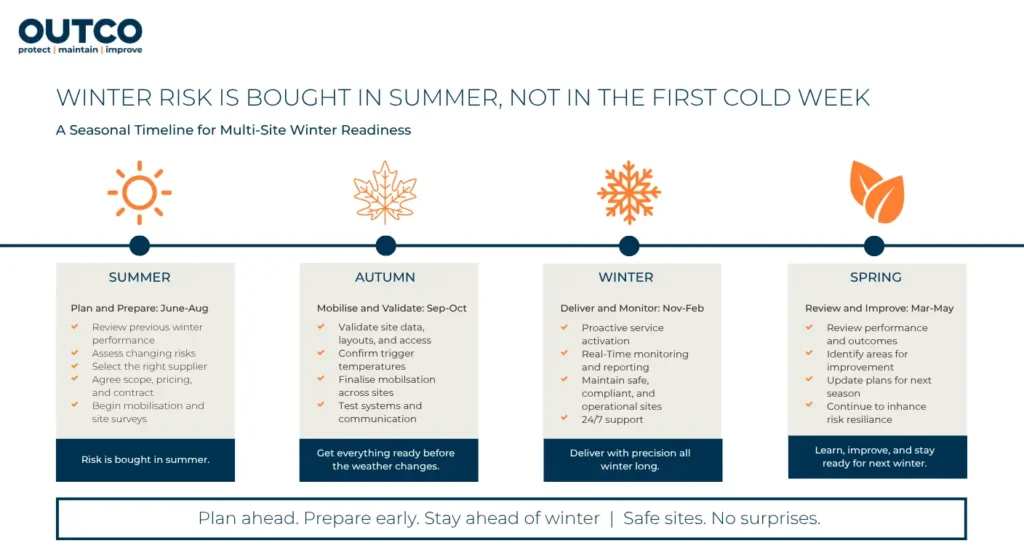
July
- Review existing contracts
- Confirm the current site portfolio
- Arrange site surveys
- Assess previous winter performance
August
- Complete site surveys
- Agree trigger temperatures
- Finalise service specifications
- Confirm reporting requirements
September
- Complete mobilisation
- Verify contact lists
- Confirm escalation procedures
- Test communication channels
October
- Complete final operational checks
- Confirm readiness across every location
- Make sure all stakeholders understand responsibilities
This phased approach reduces risk and gives both clients and gritting contractors sufficient time to resolve any outstanding issues before winter operations begin.

Questions to Ask Prospective Suppliers
Selecting a provider for winter maintenance services involves much more than comparing prices.
For organisations responsible for multi-site winter maintenance, consistency, operational resilience and visibility across the portfolio are often more valuable than headline cost alone.
Ask prospective suppliers:
- How will you mobilise services across our portfolio?
- How do you determine when gritting visits are required?
- What evidence will we receive after every visit?
- Can reporting be tailored for different stakeholders?
- How do you manage service delivery during prolonged severe weather?
- What escalation procedures are in place?
- Do you provide nationwide coverage?
- How quickly can portfolio changes be incorporated during the contract?
The answers will help distinguish suppliers that simply provide winter treatments from those that deliver fully managed winter services for businesses.
Good winter maintenance planning is about creating a clear operational framework before winter begins.
For organisations responsible for multiple locations, reviewing sites, confirming service requirements and completing winter planning and procurement during the summer reduces operational risk and improves consistency across the portfolio.
Taking the time to define requirements before autumn also makes it easier for gritting contractors to mobilise efficiently, helping to make sure your winter maintenance services are ready to protect every site from the first forecast through to the end of the season.
Book a Winter Planning Review
If you’re reviewing winter maintenance planning across multiple sites, a structured planning review can help identify gaps before mobilisation begins.
A winter planning review identifies your site requirements, defines service scope, establishes operational priorities, and plans mobilisation, so your winter services for businesses are ready before autumn.